


Previous Story
Students invent food recycling bin to manage food waste
Posted On 16 Oct 2017
Comment: Off
By Jasmine Hoe
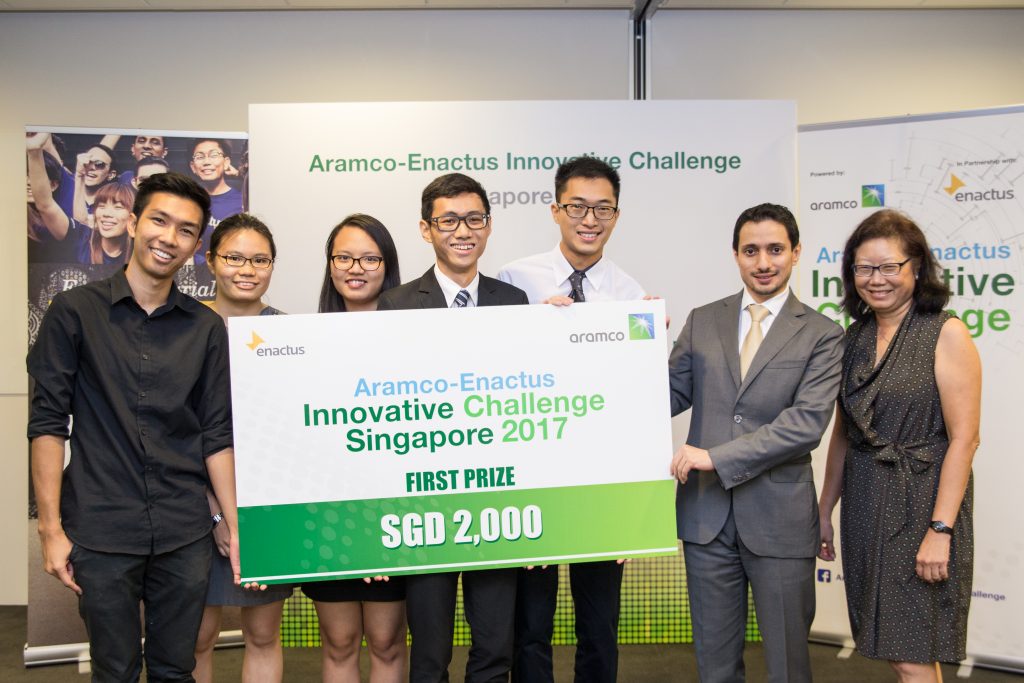
PHOTO: ARMACO-ENACTUS
The last bits of our leftover food could one day be used in the garden.
A team of eight NTU students, who named themselves Second Nature, has created a food recycling bin that converts food waste into organic fertiliser.
Their innovation landed them the first place with a cash prize of $2,000 at the Aramco-Enactus Innovative Challenge held in Singapore last month. The Challenge is an inaugural initiative that encourages university students from five Asian countries, including Singapore, to come up with creative solutions addressing environmental problems.
Second Nature is set to represent Singapore as one of the top five groups at the Aramco Asia Cup finals in Beijing next month, where they will compete for the grand prize of US$3,000 (S$4090).
The team members are part of Enactus NTU, a global non-profit organisation that aims to improve lives through social entrepreneurship.
Egwin Fan, 23, leader of Second Nature, said: “We have such an efficient waste disposal system that people have lost the sense of how difficult it is to make food.”
The invention would raise awareness about food waste among Singaporeans, added the second-year School of Social Sciences student.
Fan explained how the food recycling bin worked to the Nanyang Chronicle.
A chemical solution containing microorganisms is first added to the leftovers. After the leftovers are added to the bin, the user has to step on its pedal to activate the blades within the bin to break down the food.
The food is then left to sit for two to three days to allow the microorganisms to break down the complex food molecules into simpler forms of nutrients. The compost is then ready for use as organic plant fertilisers.
Member Eng Ying Qi, 20, attributed the win to the diverse nature of their team.
“What I think made our team stand out was the fact that we were made up of students from various disciplines, as compared to some of the other teams (who) were all engineers,” said the second-year student from the Nanyang Business School.
The team is made up of students from the Humanities, Science, Business, and Engineering schools.
Having members from different schools helped the team to focus not only on developing the prototype but on the packaging and marketing aspects as well, added Eng.
As a business student, Eng’s responsibilities included developing a business model of the bin, calculating financial projections, as well as conducting primary and secondary market research.
Members from the Engineering schools focused on the product development and design of the prototype, while those from the Science schools conducted experiments on current food waste disposal methods.
Following its victory, Second Nature is now working on improving the efficiency of their food recycling bin.
The team is currently experimenting with Aspergillus awamori — a fungus that breaks down food molecules into simpler nutrients, said member Javier Tan, 23.
“Through some genetic engineering, its digestive ability can be potentially enhanced to shorten the process for our bin,” said the second-year School of Biological Sciences student.
The team also has plans to place the bins at the various halls of residence to encourage environmentally friendly habits among residents. One such example is growing gardens within the halls.
“It can expose students to urban farming and introduce them to sustainable living, which is what our team believes in,” said Eng.
But as preparations for the finals are underway, the team’s main focus is not on the prize money.
“The whole purpose of this is to have a social mission,” said Fan, president of Enactus. “We are more environmentally-focused rather than gunning for pure profits.”