


Previous Story
S/U Changes Not Enough
Posted On 14 Oct 2013
Comment: Off
Students are not content despite the extension of the S/U declaration period to two days after the last day of examinations.
By Mark Soh
Even with the extended declaration period for the Satisfactory/Unsatisfactory (S/U) option, many students still feel it doesn’t serve the purpose of helping them improve their Grade Point Average (GPA).
Previously, students had to make the declaration two weeks before the examination period. But from this semester, students will have instead two working days after the last day of the university examination period to declare their S/U option, announced the NTU Students’ Union (NTUSU) on 23 Sept.
The scheme was revamped following a proposal from NTUSU to the university, according to Professor Kam Chan Hin, Associate Provost (Undergraduate Education).
The NTUSU proposed to extend the declaration period so that students can better decide whether or not to utilise the S/U option after gauging their performance at the examinations.
For this reason, students feel the move isn’t enough. They think the system at National University of Singapore — where students have three days after they received their examination results to utilise the S/U option — is more reasonable.
Mr Dang Chun Kin, 26, a recent graduate from the School of Electrical and Electronic Engineering (EEE), said: “If NTU wants to give its students a competitive edge over graduates from other universities, we should have the same system as them.”
In response, Prof Kam said: “Allowing a change of S/U option after the results are known is tantamount to allowing students to manipulate their GPA. That was never the intention of the NTU S/U system.”
Instead, the university’s intent was to encourage, and hopefully motivate students to be more adventurous and explore courses outside their specialisation, Prof Kam said.
However, some students do not feel that the S/U option motivates them to venture beyond their discipline.
Tommy Quek, 24, a third-year student from the School of Computer Engineering said: “Even though the university’s intention with the S/U option is to encourage students to take modules outside their own major, I would not venture too far out of my comfort zone, and stick to taking a module that I have some background in instead.”
Wong Zhibin, 21, a first-year student from the School of Mechanical and Aerospace Engineering added: “If we can’t see our results, it will still be a gamble when deciding whether or not to utilise the S/U option.
“The new scheme will not be useful for students until we get to see our results,” he said.
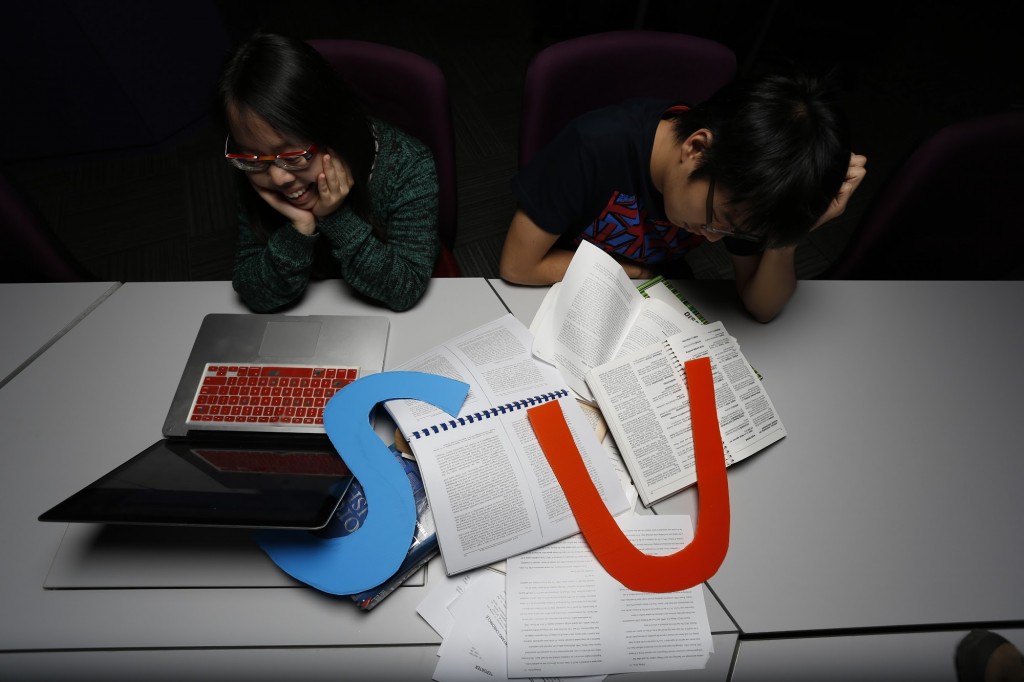
DECISION MAKING: The S/U option has been viewed by many students as critical in determining their grades.
PHOTO ILLUSTRATION: LIM MU YAO
This shows that many students see the S/U option as a critical game changer that may have serious implications on their GPA, even though Prof Kam has said that the S/U option was not implemented for that reason.
That was the case for Ms Elizabeth Soh, 26, a recent graduate from the Wee Kim Wee School of Communication and Information.
She missed out on second upper class honours by a GPA of less than 0.1 because she exercised one wrong S/U option.
“I was advised to exercise my S/U option halfway through the semester by the tutor of a singing elective, only to find out after from the same tutor that I had gotten a B plus for the course,” she said.
“Things would have been different for me if I had the choice to S/U an elective after an exam back then,” she added.
On the other hand, the change was well-received by some students who were relieved that at the very least, they could sit for the examinations first, before deciding whether to utilise the S/U option.
Donovan Goh, 21, a first-year student from EEE, who has heard of “horror” stories like Elizabeth’s case from his seniors, said: “At least under the new scheme, I am more assured that the same thing will not happen to me.”


