
Previous Story
Tackle bullying with a velvet glove
Posted On 15 Oct 2015
Comment: Off
By Joel Lim, Dapper Editor
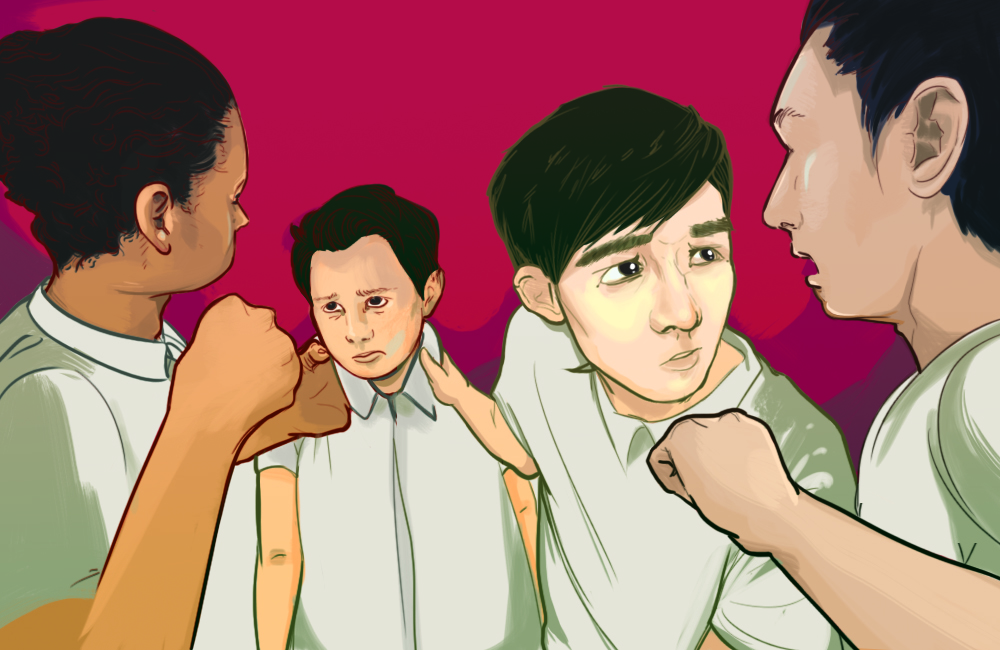
FIGHTING FIRE WITH FIRE: Not all bullies are receptive to the “iron fist” approach.
(GRAPHIC: KIMBERLY ANG)
A national conversation about bullying was sparked in late September, when a video of a Shuqun Secondary School student bullying his classmates went viral. In the backlash that followed, parents and teachers alike called for harsher punishments to deter bullying in schools.
However, schools already have punishments in place for bullies, and while these may have short-term deterrent effects, they may not translate into long-term behavioural change. They tell the bully that he has done something wrong, but not why his actions are unacceptable and why he should stop.
In addition, adolescent bullies are at an age when they are not afraid to defy authority, especially if they do not feel as if they have done anything wrong. As in the aforementioned incident, the bullying had been going on for months, and continued even after the teacher confronted the bully. The bully later threatened one of the victims for telling on him.
Students can react strongly when they are “told on” by their peers, something I experienced as a student myself. A classmate and I had a disagreement, and to resolve the argument, she approached our form teacher instead of first trying to iron out matters with me. When my teacher confronted me, my immediate reaction was anger at my classmate. I felt that going to the teacher was elevating the problem unnecessarily, and I was in no mood to listen to what my teacher had to say.
I did not act on my emotions, but my classmate’s action intensified the animosity I felt towards her, even though it was only a minor disagreement. Imagine how much worse the reaction can be with a bully.
Since the route of punishment is not always effective, we should explore other ways to deal with bullying. Sometimes bullies themselves are unaware that their actions constitute bullying. We should allow bullies to comprehend the severity and consequences of their actions, not only on themselves but on others. After all, teenagers are still learning what constitutes socially acceptable behaviour.
Instead of acting as disciplinarians, teachers and classmates can encourage bullies to reflect on their actions by talking to them about it in a non-aggressive manner. This can work especially well in cases where the behaviour has not yet escalated to a level that warrants severe punishment.
I was once in a situation where the bully was one of my friends. He was mocking a classmate’s appearance and hurling items at him. When the class monitor tried to intervene, telling him to leave the other student alone, my friend merely laughed him off. It was only when I pointed out that our classmate was in tears, that my friend stopped.
Because I avoided taking the class monitor’s offensive stance, the bully was more willing to listen to me. We had a talk about the incident afterwards and he apologised to the classmate when he realised that his behaviour had crossed the line. They may not have become best friends after that, but the bullying stopped without a need for punishment.
Often, the bullies’ aggressive actions reflect self-esteem issues and behavioural problems. In such cases, we must be aware of these underlying reasons and avoid a heavy-handed approach in order to help them change for the better.
We should also encourage victims to take a stand against their bullies. While many applauded the boys in the Shuqun Secondary incident for not retaliating, I felt that doing so sent out the wrong signals. Bullying reflects an imbalance of power between the bully and the bullied. Since the students did not express their feelings, their silence validated the bully’s illusion of power.
A study by the Singapore Children’s Society found that asking the bully to stop was perceived to be the most effective action for victims. In other words, being straightforward can have immediate positive results.
Subjected to racist taunts in secondary school because of my darker skin colour, I did what I had been taught was the best initial reaction to bullying — I ignored the perpetrator to avoid conflict. However, he took my silence as permission to continue taunting me.
When the bullying intensified and I felt that I had enough, I approached him to express how uncomfortable his words made me. He shrugged me off at first, but he stopped harassing me after that. This is just one alternative strategy I have found to be effective, and it can have better results than informing teachers or parents.
It would be naïve to think that we can abolish all punitive measures — but it should never be our first or only option. By incorporating character development, we offer the bullies a chance to change their behaviour for the long term.


