


Previous Story
TED Talks Luck
Posted On 01 Nov 2013
Comment: Off
University of Arizona professor says luck can be created from problem resolution.
By Mark Soh
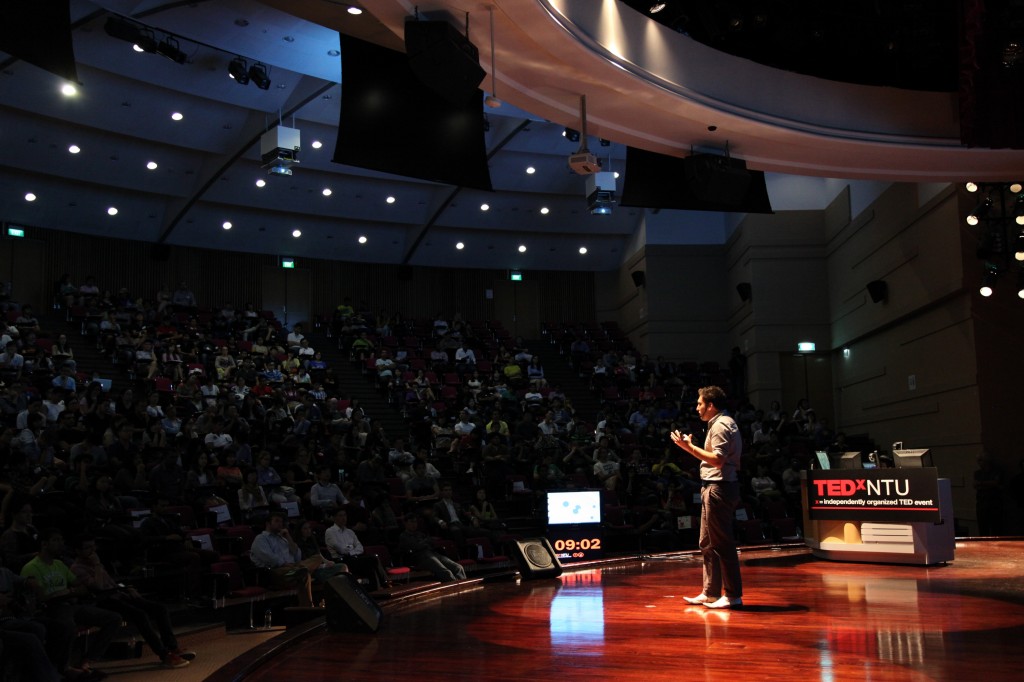
TALKING LUCK: Dr Hallam Stevens, one of seven speakers at the TED conference, said that we can create our own luck.
PHOTO: VICTOR LI QI
Luck can be created, and we are creating luck every day.
That is according to John Lansing, an ecologist and a visiting professor of Anthropology from the University of Arizona who explained that we create luck subconsciously according to how we think and act. “We make our own luck from problem resolution,” he said.
He cited the example of farmers living along a hillside river in Bali who made their own luck by solving their farming problem. To increase farmable land, they began carving stepped terraces out of steep slopes of hills in order to increase their yield of rice crops and survive.
These rice terraces also allow crops to be watered by rainwater flowing down from hilltop forests, and have become a very efficient way of growing crops, growing enough to feed more than a thousand people per square kilometre. Dr Lansing said that the farmers were trying to solve their problem, but as a result, found a solution that optimises irrigation flows and crop productivity for many countries.
He was one of seven speakers at this year’s TEDxNTU conference held at the Lee Kong Chian Lecture Theatre on 19 Oct. This year’s conference, entitled The Luck Factor, had speakers from universities both local and abroad giving their take on how luck affects our lives.
Returning for its third year, TEDxNTU is an independently organised offshoot of the global brand Technology, Entertainment, Design (TED).
The original TED conferences, held annually in the US since 1990, have had Al Gore, Bill Gates and Jamie Oliver among its list of distinguished speakers.
Mr Vivek Manoharan, 25, leader of the team that organised this year’s TEDxNTU conference, said: “We chose the topic of luck because it is present in our everyday life, and it is a mysterious, intangible, and intriguing topic to boot.”
Luck is commonly defined as a chance happening of fortunate or adverse events that one does not have control over. But speakers at this year’s conference appeared to have little belief in the element of mystery in luck.
Dr Preston Greene, 29, an assistant professor of philosophy at NTU, said: “Whether other people view our successes as due to luck or skill can have a huge impact on our self-esteem.
“Self-perception affects how confident we are of succeeding, be it achieving good grades, making a team, or getting a job.”
In short, he explained that the more we view ourselves as skillful, the more successful we would be.
However, some students weren’t convinced that one’s fate has to do with self-perception. Shereen Ng, 20, a second-year student from the Renaissance Engineering Programme, still believed that luck largely determined the course of one’s life. She said: “I believe that no one can alter our births. It is by luck, or chance, that we are born into a wealthy or poor family.”
“If it is by luck that I’m born into a wealthy family, then I will have better and more opportunities to receive education. With education come skills, and skills will allow me to draw a higher salary and afford a higher standard of living,” she said.
“All that is not likely if I’m born into poor family,” she added.


