


Previous Story
The Degree Dilemma: Will Paper Qualifications Matter Less?
Posted On 19 Aug 2014
Comment: Off
In his rally speech, PM Lee advocates for a cultural shift to allow non-graduates to rise in their careers. However, our society may not be ready for this dramatic change in mindset.
By Lo Yi Min
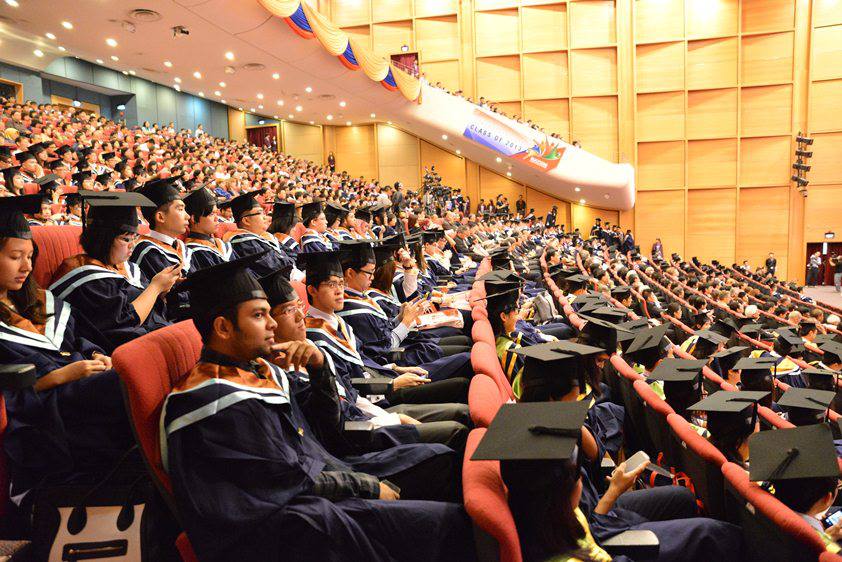
New NTU graduates are still likely to find that their degrees are valuable in the working world.
PHOTO: NANYANG TECHNOLOGICAL UNIVERSITY FACEBOOK PAGE
$300 a month — as a fresh polytechnic graduate, that was the salary I received for my internship at a publishing house. I learnt later from my employer that university undergraduates earned an additional two hundred dollars for the same job.
The disparity is clear. A university degree still holds more weight in the working world than any other academic qualification.
However, this could soon be a thing of the past. There has been a slew of recent changes to Singapore’s education policies, with Prime Minister Lee Hsien Loong encouraging a “cultural shift” in his National Day Rally speech on Sunday (17 Aug).
Mr Lee called for Singaporeans to value a person based on his character and contributions rather than his paper qualifications. He congratulated Keppel Offshore & Marine employees — Institute of Technical Education (ITE) graduate Ms Dorothy Han and Polytechnic diploma holder Mr Abu Bakar — who both rose through the ranks to supervisory positions.
These individuals push the notion that a person’s merit cannot be merely defined by academic certificates. There are many aspects to how one needs to communicate effectively, work in a team, be proactive and take on responsibilities in a job. Skills, experience and performance should also factor into the assessment of one’s capabilities. And companies here need to recognise this.
In November last year, the Applied Study in Polytechnics and ITE Review (ASPIRE) Committee was tasked to review and recommend ways to strengthen links between industries and non-degree post-secondary institutions. The move aims to channel employers’ attitudes towards welcoming non-degree academic qualifications.
But this cultural shift appears to be at odds with Singapore’s high regard for excellent academic performance. For a society that prides itself with selecting and rewarding individuals based on academic merit, it is hardly surprising that many employers evaluate potential employees based on their paper qualifications.
This is evident in the workplace, where some organisations in the civil service continue to seek only university graduates for management positions, and place employees on different career progression tracks, based on whether or not they hold a degree. Attempts to encourage this cultural shift will only be lip service if this shift is not recognised on a nationwide scale.
Mr Lee’s example of the People’s Association (PA), with its single scheme of service for both degree and diploma holders, is commendable. But this is more likely to be the exception rather than the norm.
For instance, those who are looking to become teachers through the National Institute of Education (NIE) are categorised into two tracks, based on their level of education. The General Education Officer 1 (GEO 1) is a track for degree holders, while the GEO 2 is a track for polytechnic diploma holders. Following this scheme, polytechnic graduates are paid about two-thirds the starting salaries of their university graduate counterparts, and they follow a different payout scheme throughout their teaching careers.
This pattern continues in uniformed organisations within our civil service. The Ministry of Defence (MINDEF) has separate salary schemes for diploma and degree holders in their officer scheme. Notably, a Lieutenant who graduates from university with good honours can earn close to two times that of a Lieutenant who graduates with a polytechnic diploma.
Moreover, in the Singapore Civil Defence Force (SCDF), only degree holders are eligible for the position of Senior Officer. This criteria reminds us of the doors that a degree can open for us. A skilled firefighter — who has served the force as a Junior Officer and has accumulated years of field experience — would still not qualify for promotion to the senior level unless he or she earns a degree.
However, on a positive note, the government has recognised the need to make groundbreaking change. The anticipated recommendations by the ASPIRE Committee will hopefully push more companies towards judging individuals not simply by their academic qualifications, but also by skills and experience.
Mr Lee also announced the setting up of a tripartite committee to develop an “integrated system” of education, training and career progression for Singaporeans. This committee will promote skill-based industry support and recognition.
However for the changes to take effect, we as a society must fully embrace qualities beyond that of the academic certificate.
In the meantime, as our decades-old fixation on scholastic excellence prevails, don’t expect the paper chase to slow down.


