


Previous Story
To Be or Not To Be … A Man
Posted On 04 Dec 2014
Comment: Off
By Masayoe Nabilah
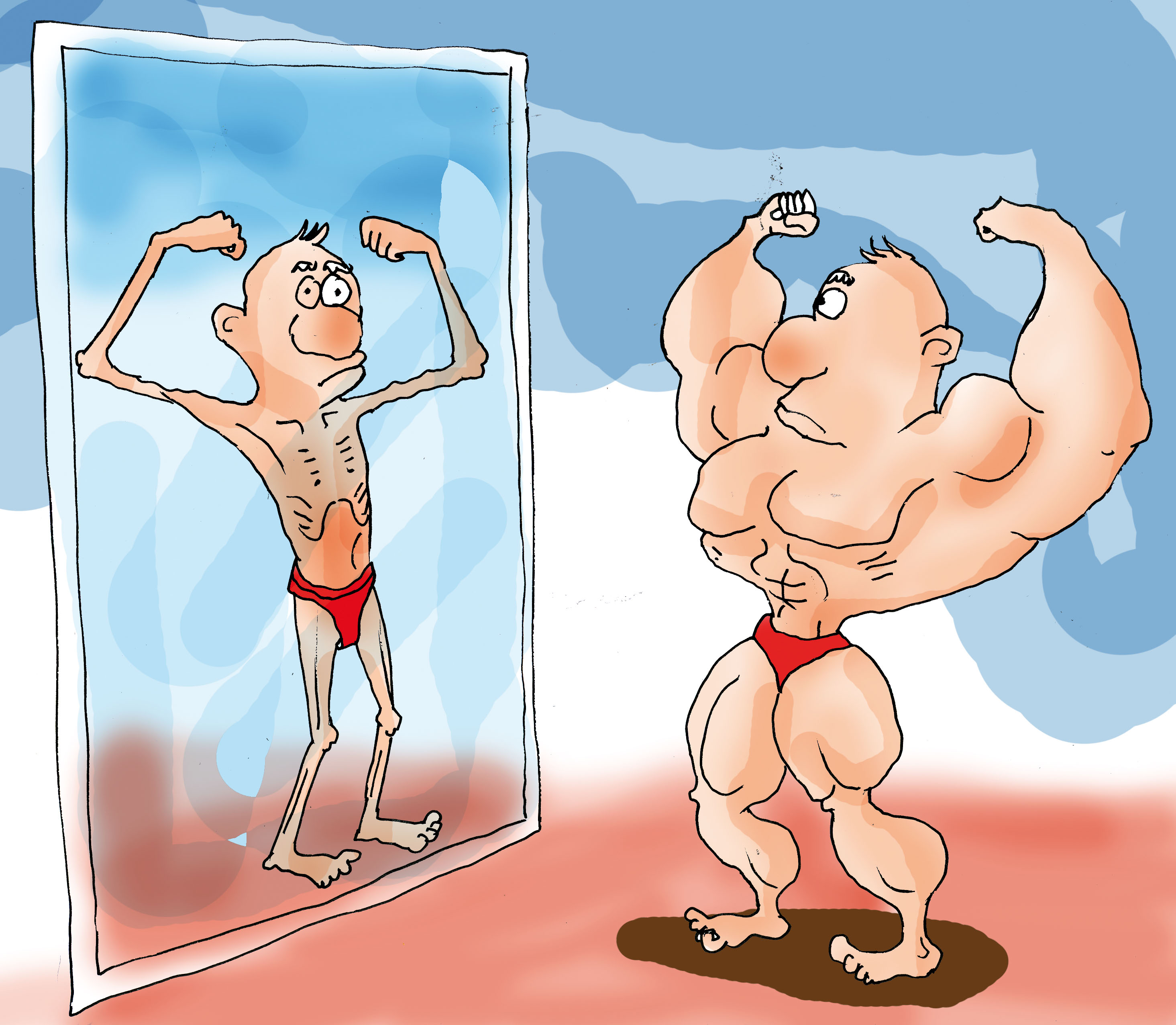
TOO SMALL: Males are more likely to suffer from the perception that they are not muscular enough. (GRAPHIC: INTERNET)
Five years ago, I succumbed to societal pressures of the ideal body image and walked into the welcoming arms of anorexia nervosa. The complex eating disorder saw me starving myself to satisfy my misconstrued desire to be thin.
The mirror became my worst enemy; the weighing machine was a drug that I became addicted to. Skipping a day of exercise caused much anxiety — my body was all I could think about.
I eventually came clean about my disorder. But even when I didn’t ask for support, help had already begun to steam in from my family and friends.
Looking back, it may have been because I am a woman, and had therefore been perceived as vulnerable and more susceptible to body image issues. As such, I received a lot of help and support during my ordeal.
But while much has been said and done to help women like me, it is becoming apparent that men can suffer from similar afflictions too.
A 2007 Harvard study found that males accounted for 25 per cent of patients suffering from anorexia or bulimia, and they also made up approximately 40 per cent of those with binge-eating disorders.
And in recent years, a new eating disorder has emerged. Termed muscle dysmorphia disorder, or reverse anorexia, it refers to men being obsessed with bodybuilding and feeling that they are not muscular enough.
The Alliance of Eating Disorders Awareness, based in the United States (US), states that approximately 10% of the men in the US who are obsessive gym-goers have this disorder.
While it is clear that men can feel insecure about their bodies, their ideal image of themselves generally differs from that of women. 20 per cent of the people who seek help for eating disorders in Singapore are men. In general, men mostly desire lean and muscular arms, shoulders, thighs and abdomens, wrote Evelyn Boon, Senior Principal Psychologist at Singapore General Hospital, on Singapore-based portal Health Xchange.
In an interview with the Daily Mail, Professor of Psychiatry at Harvard Medical School Harrison Pope said: “These conditions have probably become more common among men in response to changing societal standards of male body image.”
However, Prof Pope added that the symptoms of body image disorders in men can be hard to recognise, especially when doctors and men themselves wrongly associate anorexia and bulimia exclusively with women.
This could be due to societal expectations of masculinity, such as being tough, self-reliant, and able to take control of situations. However, this runs contrary to the fact that men can suffer from physical or mental health problems themselves.
You’re a dude, it’s not okay
Hollywood’s physically flawless men are also no strangers to the evil mechanics of body image dissatisfaction.
One such victim is Ashley Hamilton, who played former military officer Jack Taggert in Iron Man 3. The 39-year-old actor had silently suffered from bulimia and anorexia, at least until he decided to publicly speak about his eating disorders early last year.
Hamilton admitted that the journey to recovery was, and still is, excruciatingly painful, especially with the social stigma that men face as a result of the feminisation of body image issues.
“Nobody wants to talk about (body image issues). It’s really shameful as a man to have that,” said Hamilton in an interview with People magazine online last year.
In a column on Huffington Post online last year, Kate Fridkis, author of Growing Eden and blogger at Eat the Damn Cake, recalled how a friend’s boyfriend wouldn’t eat and wouldn’t go for therapy. He exercised for hours on a daily basis, and felt “disgusting” when he couldn’t go for his gym sessions. He got “dizzy” from being up and about, but claimed that he was alright and that he “knew what he was doing”.
Men want to look good
While women like myself tend to uphold the ideal of a slim appearance, men desire the traditional masculine ideology of a mesomorphic body — well-developed chest, narrow waist, and toned upper bodies. Their desire for body perfection leads them on the pursuit of muscularity, which is perceived to be an explicit representation of masculinity.
This ideal body image desired by men stems from the media –– a force powerful enough to influence our behaviours, attitudes and opinions.
It is common to hear women expressing their discontent with the media for dealing them with a cruel hand through its portrayals of the ‘perfect’ body — slim waist, curvy hips and toned legs in a bikini. But we tend to forget the silent sufferers — men — who are also force-fed images of the ideal male body.
Beginning with USA Today last year, news media outlets have reported on a rising trend in the number of undressed male models in commercials last year. The proportion of undressed men in commercials has increased dramatically in leading US women’s magazines Cosmopolitan and Glamour, from 3% in the 1950s to 35% in the 1990s, stated the 2004 study, Biceps and Body Image: The Relationship Between Muscularity and Self-Esteem, Depression, and Eating Disorder Symptoms.
How can an ordinary man “be a man” when confronted with images of male models who may appear more masculine than they do? When looking at these media images, there is a tendency for social comparison as men begin to evaluate their level of attractiveness based on the male models they see.
We are evil too
We, too, are guilty of body image obsession. The media may have planted the seed, but we have allowed ourselves to water it and watch it bloom into a relentless obsession with idealistic perfection.
For instance, women may also find these picture-perfect men attractive, which could increase the sociocultural pressure on men to conform to these expectations in order to be deemed attractive.
Also, excessive concern about male body image goes against the ideals of masculine strength and confidence. Men with body image issues may feel ashamed of their perceived “feminine problem”, and hence, refrain from seeking help.
What needs to be done
Schools and support organisations can increase public awareness of this issue, by educating us on ways to identify the early symptoms of body image dissatisfaction, and disseminating information about binge eating and compulsive exercising.
Friends and family can also help to stop the problem in its infancy, as behavioural and health problems in men may be usually more difficult to detect, as compared to women.
Men may turn turn to exercise regimes such as running and lifting weights at the gym to lose weight and sculpt their bodies, and these may appear, on the surface, to be simply efforts at keeping fit.
Some of the more obvious signs of body image dissatisfaction include a preoccupation with weight and calories, unexplained rapid weight loss, compulsive exercising, excuses to skip meals, and visiting the bathroom straight after meals.
If these warning signs are observed, friends and family should voice their concerns. Get the conversation about the problem going; show compassion and support to ease the victim into opening up about his feelings.
While more can be done in terms of education, the best solution may lie in the victims of body image dissatisfaction themselves. Men suffering from eating disorders and compulsive exercising need to realise that there is no shame in seeking help.
According to the American National Association of Anorexia Nervosa & Associated Disorders, the first step to recovery is to admit that there is a problem.
Although I had suffered from body image dissatisfaction five years back, I knew that my expectations of my body were unrealistic, and I had to fight off those expectations.
While it was difficult at first, I eventually came to terms with the problem after sharing my insecurities with family and friends who were always willing to listen. What victims fail to realise is that they are not alone; there is always someone who is willing to help.
From someone who understands what it’s like to have body image issues and an eating disorder, I say: Don’t buy into the warped temptations of the media and don’t be too hard on yourself. Silence the inner ‘mean boy’ and let the real you shine through.
This is what family and friends told me, as well as what I kept telling myself while I was on the road to recovery. It worked for me, and it could work for you too.
We are our own agents of change; we possess the power to refuse or welcome negative influences that define what we look like.


