


Previous Story
Trump vs. Clinton: The impact on US-Singapore relations
Posted On 31 Oct 2016
Comment: Off
By Gowri Somasundaram
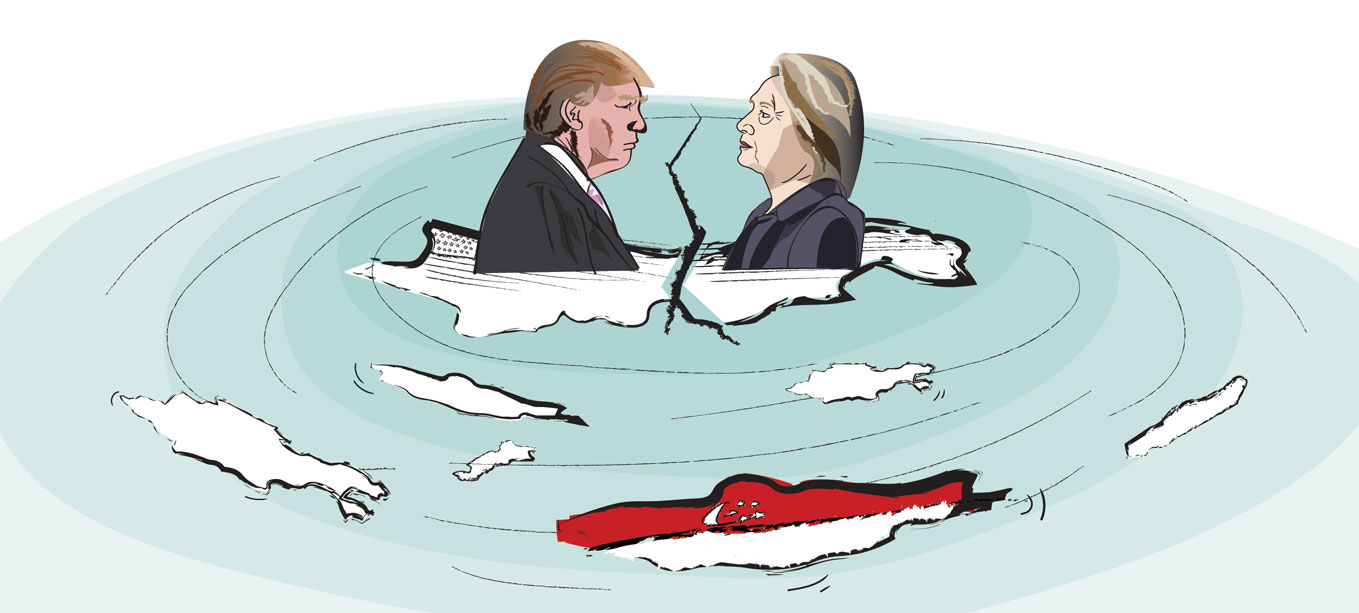
GRAPHIC: TAN ZHUO HUI
The outcome of the United States presidential election will determine if Asia and, in turn, Singapore grows closer to the US — or further apart, experts say.
Come 8 Nov, Americans will take to the polls and decide between Mr Donald Trump or Mrs Hillary
Clinton, therefore determining the future state of relations between the US and Singapore.
Singapore and the US are longstanding allies and commemorated their 50th anniversary earlier this year. America is also Singapore’s largest foreign direct investor.
Under the current Obama administration, both countries extended strong trade and military ties, securing solid bilateral relations.
But experts say that a change in administration could affect the region and ties with Singapore.
This stems from the candidates having attitudes towards Asia that are starkly different from President Barack Obama’s. They also have opposing understanding and interpretation of foreign relations.
“Mr Trump will be more transactional and calculating, and he does not necessarily understand the nuance of geo-politics when it comes to foreign relations,” said Assistant Professor Daniel Chua from the S. Rajaratnam School of International Studies, whose interest lies in military studies.
In contrast, Mrs Clinton’s track record of having been in the Senate, as well as being Secretary of State and the First Lady, makes her proposals regarding foreign relations appear more credible.
Experts also say a Clinton administration is likely to continue to maintain strong ties in the region.
“I think it makes the world safer and, frankly, it makes the US safer,” said Mrs Clinton during the third and final presidential debate on 19 Oct. “I would work with our allies in Asia, in Europe, in the Middle
East, and elsewhere. That’s the only way we’re going to be able to keep the peace.”
Countering Chinese might
Assistant Professor Kei Koga, under the Public Policy and Global Affairs Programme from the School of Humanities and Social Sciences, said the former Secretary of State also has a vested interest in the region because strong relationships with Asian nations can offset the growing might of China.
“Should Mrs Clinton win, she may be able to counter China’s assertiveness in the region by strengthening ties with Japan and the Philippines,” he added.
Philippine President Rodrigo Duterte had earlier announced his country’s separation from the US in a forum during his visit to China. However, he later claimed that he was not severing ties, but adopting a more independent foreign policy by strengthening the Philippines’ ties with China.
As such, either a Trump or Clinton administration will have to implement drastic measures to achieve an ideal state of relations in the region.
However, a Trump administration raises questions on future US-Asia relations.
Mr Trump claimed that the US is being ripped off when it comes to defending countries such as Japan.
“We are spending a fortune doing it. They have the bargain of the century,” he said during the final presidential debate in Las Vegas.
Asst Prof Koga said: “I think Mr Trump understands the importance of the alliance. So, I believe that it is not going to be the dissolution of alliance but more of a change in dynamics.”
Mr. Trump could also seek to undo President Obama’s legacy of “Pivot to Asia”.
This strategy has strengthened US relations with almost every country in Southeast Asia. America’s presence in the Asia Pacific region has indeed helped the countries deal with the rise of China, Asst Prof Koga added.
The removal of America’s presence could create a vacuum, which will present China with an opportunity to rise as the predominant power in the region.
“If the next President somehow neglects to strengthen US relations with the East Asian countries, China might see an opportunity to strengthen its relation with the region,” said Asst Prof Chua.
United they stand
While both candidates are on opposite sides of the court when it comes to foreign relations and leadership styles, one thing they stand together on is the Trans-Pacific Partnership (TPP), which they both oppose.
The TPP is a major trade agreement with 12 countries, including the US, Singapore, Japan, Australia and other countries in the region.
It aims to bring down trade barriers, facilitate flow of goods and promote trade among the countries.
Currently, Singapore has free-trade agreements with all the countries involved in the TPP except for Canada and Mexico.
With the TPP, Singapore’s economy can see a boost of 1.4 per cent by 2025. It will also lift curbs on the foreign ownership of companies, in sectors such as private healthcare.
While this may provide opportunities for Singaporean companies to invest abroad, they will still have to compete with local companies.
All in all, with the TPP and other foreign policy changes that can be expected with a new Commander-in-Chief in the White House, change is inevitable for our tiny city-state.
At the end of the day, Singapore needs to be ready to deal with this change in dynamics in Asia as well as in trade ties — regardless of the election results.