


Previous Story
What anger can turn you into
Posted On 24 Jan 2017
Comment: Off
By Gowri Somasundaram
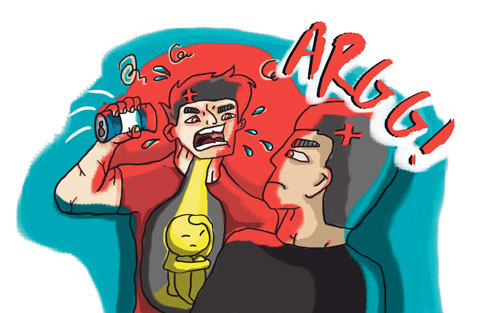
GRAPHIC: ALFRED YEO
After an argument with my brother, my living room reeked of talcum powder for an entire week.
I had, in a fit of ire, smashed a small bottle of said powder against the wall.
Sadly, these incidents sometimes happen as a result of pure instinct. This was just one of the more recent incidents where my anger reared its ugly head.
Now, I am not justifying it. But while many may only see the moment of anger, the aftermath for the person dealing with it is more excruciating than some might think.
For the next few hours, I remember crying and feeling regretful, guilty and embarrassed.
Of course, my family often discuss anger management with me. While bringing up the topic would ironically make me angry all over again, my perception of handling it has changed in the past few years.
I had started to observe the irreversible impact of anger on my relationships when I was in my first year in junior college.
Looking back at a lost friendship in secondary school, I realised how short-sighted I had been over a passing comment on an unfavourable habit of mine.
I had been unnecessarily defensive, even launching into a personal attack on the friend who had made the comment. I brought up past grievances, and it quickly devolved into an irreconcilable mess.
A moment of rage was all it took to put an end to a three-year-long strong friendship.
The concept of rage is expressed by Thomas J. Harbin in his book ‘Beyond anger: A guide for men: How to free yourself from the grip of anger and get more out of life’.
He said that rage is the “tendency to react with instant anger”, something that is not a response to any specific event.
“When you react to more and more situations with anger, it becomes your habitual response. You may often find yourself furiously yelling or seething inside without even knowing what it was that made you angry,” he further wrote.
These words resonated with me because this described my behaviour every time I got angry.
The turning point came when I met the friend I had fallen out with during an event at my junior college. It was then that I realised the impact my anger had made.
I decided it was time to change.
I tried a couple of different tactics; the most popular advice on anger management you can find on the Internet is to walk away from the situation, calm down and then come back only when your anger has dissipated.
I have taken refuge in movie theatres to avoid interaction with anyone for a few hours. While it does feel good at the time, it did not help to release my anger.
In my opinion, avoidance is by far the worst tactic to use when a person is raging.
Anger does not vanish when you focus on something else. It just continues simmering underneath your skin until it is resolved.
Instead, my best strategy to date has been to identify possible sources of conflict and tackle them before an argument starts.
Confronting a conflict before it actually happens can and has backfired on me multiple times, especially when the intent is not communicated properly.
Hence, the success of this strategy, I would say, lies in how one manoeuvres through the conversation.
But the one thing that I realised was that it got easier every time. It got simpler to identify sources of conflict because I was able to control myself and my emotions better. It got easier to talk to people around me. And it was better to reach a compromise without lashing out.
If a particular habit of someone you know irritates you every single time, do not wait for the moment when they do it again or when you are in an already foul mood.
Address it when the thought pops in your head and the mood is lighter. It makes a huge difference in the way the conversation goes and there is a higher chance of achieving a win-win situation.
They say words are the most destructible weapon one can unleash in times of anger. And I am no exception to it.
You cannot take back what you say in the heat of the moment, and I am guilty of causing serious hurt because of that.
There are so many words I would like to take back and countless instances that I would like to relive. However, when simple actions can make a difference, it is definitely worth the try.
In trying to win the argument, my anger has made me lose over and over again. It has proven time and again to be a personal weakness.
The thing about anger that not many realise is that while others may get hurt from an outburst, the damage to the person holding on to it can be even more severe.
As such, this quote by American writer Mark Twain is one that I keep in mind whenever I try to hold back my anger.
“Anger is an acid that can do more harm to the vessel in which it is stored than to anything on which it is poured.”
I could not agree more.