


Previous Story
Wrestling with weight woes
Posted On 10 Feb 2016
Comment: Off
By Sean Loo
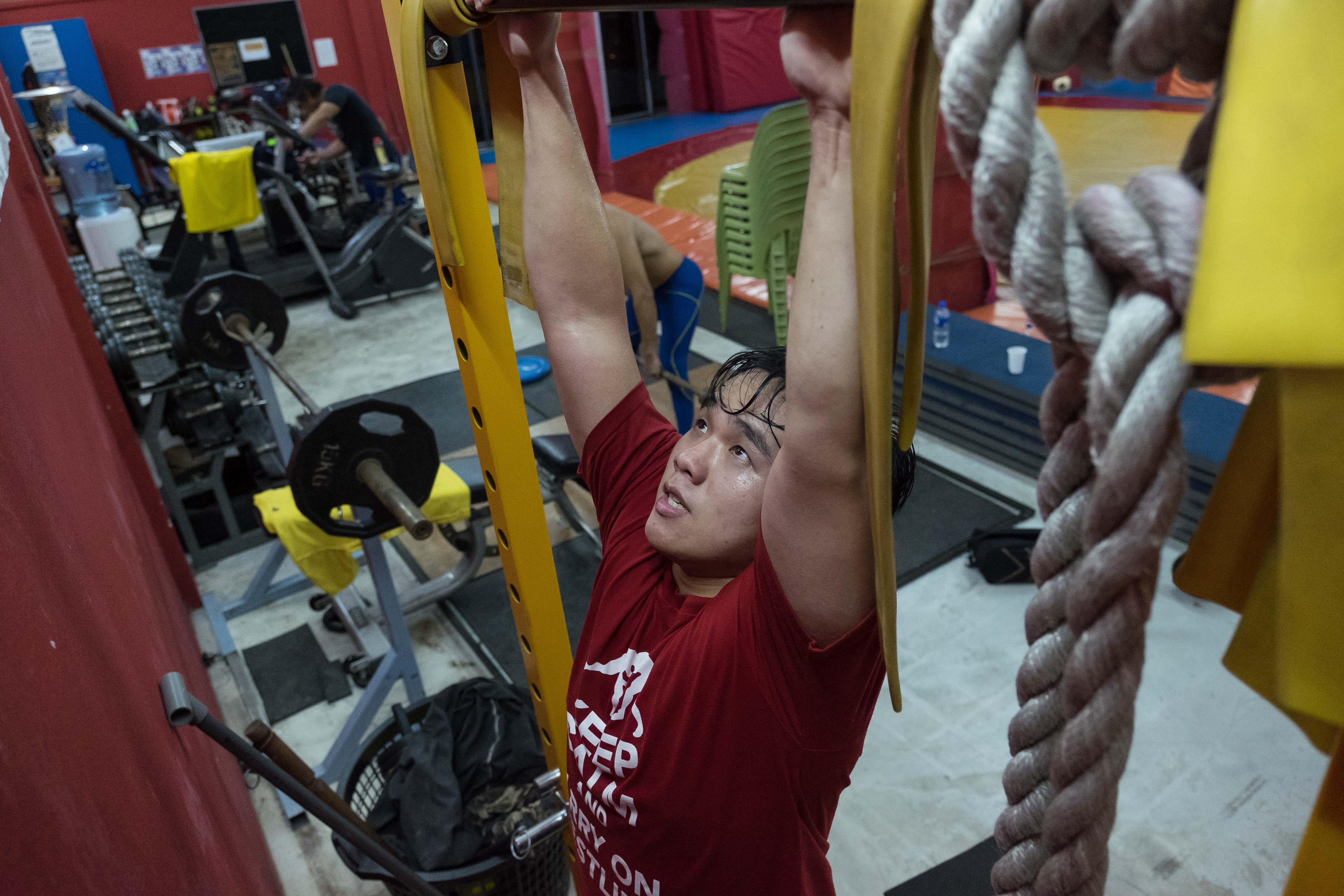
Chen plans to cut his weight by another 10kg as he believes he would be more competitive at a lower weight class. He now adheres to a strict, balanced diet of chicken, vegetables and rice. PHOTO: KENJI KWOK
He gave up sweets for something sweeter.
Dominic Marc Chen lost 20kg five months after he took up wrestling during his freshman year. In 2014, he gained a spot on the Singapore national wrestling team after clinching a bronze medal at the national wrestling team trials.
“I love desserts, I love sweet stuff; but for the sport, I have to sacrifice all of these,” said the 24-year-old.
Despite standing at only 165cm tall, Chen initially weighed about 105kg, putting his Body Mass In- dex (BMI) at 38.6. A BMI value of 23 and above indicates an unhealthy weight range, according to Health Promotion Board guidelines.
The former rugby prop said he needed to be 110kg to play effectively in his position at the A Division level.
“I’m not really tall, so whatever weight I gain, I’ll grow sideways. That’s very unhealthy,” said Chen, who now weighs 78kg.
Apart from health concerns, Chen wanted to lose weight to improve his chances of success in wrestling.
The NTU undergraduate attributed his weight loss to “30 per cent exercise and 70 per cent diet.” He avoided junk food and stuck to a strict exercise regimen to improve his wrestling prospects.
Chen would train twice a day. In the morning, he would head down to the gym for strength training and conditioning. In the evenings, he worked on his wrestling technique and sparred at the Wrestling Federation of Singapore (WFS).
Chen’s meteoric rise to the national team’s ranks was a pleasant surprise for national wrestling team captain Toh Xin Ran, 21.
Chubby kid
“He used to be a chubby kid,” said Toh. “But now he is representing Singapore.”
National team coach Paulo Delos Santos believes Chen is an “improving wrestler” and expects him to compete at top-level international competitions, such as the Asian Wrestling Championships and World Wrestling Championships.
“I expect Dominic to medal at the Asian Championships in the future,” added Mr Delos Santos, 38, a former SEA Games medallist from the Philippines.
Chen’s sweet tooth was not the only obstacle he had to overcome on his road to wrestling glory.
His parents were initially hesitant about his participation in a combat sport.
“In World Wrestling Entertainment (WWE), the matches would end up very bloody.
“That formed the baseline of what wrestling is in my parents’ minds,” said Chen.
Their fears were dispelled after watching him compete in his first tournament in 2013.
“They saw that it was a very safe environment, and there were medics involved in the tournament to tend to anyone who was injured straight away,” he said.
“Now, they come down to all my competitions to show their support.”
Last year, Chen also had to deal with the disappointment of the exclusion of his sport from the Southeast Asian (SEA) Games.
He was slated to make his SEA Games debut, but the sport was unexpectedly excluded for the first time in seven editions of the biennial event.
The exclusion emphasised the need for the national team to “win more medals” in other regional competitions to raise the profile of the sport, said Chen.
And so he did, at last year’s SEA Wrestling Championships, a regional tournament organised to replace the SEA Games event. Chen won a silver medal in the Greco-Roman 75kg weight category.
Finding the right balance
Despite already having a rigorous training programme implemented for him, Chen still turns up “hours ahead of practice” to train on his own, said WFS operations manager Gabriel Huang, 29.
Mr Huang, a former SEA Games athlete, added: “Hard work pays off and his success is a great testament to that.”
While it can be challenging having to juggle his wrestling endeavours, school work, and helping out in his family business on a part-time basis, Chen thanks his friends for helping him keep up with his school work.
The self-discipline required in wrestling also guides his academic life.
“If you don’t put in as much effort or more than what you do in training, then your studies will suffer,” said the third-year student from the School of Mechanical and Aerospace Engineering.
This tightrope walk between his studies and wrestling career will become more pertinent for Chen in the days ahead.
He already has his sights set on next year’s SEA Games in Malaysia – if wrestling is included – and the 2018 Commonwealth Games in Australia.


